

Hairline cracks are narrow, shallow, and result from normal curing and temperature movement. This affects appearance but not wall performance, and can be sealed to prevent moisture entry. Structural cracks are wider, deeper, and caused by building movement such as settlement or seismic forces. This allows moisture to accumulate behind the EIFS, leading to functional damage that requires a full-depth corrective repair.
In this guide, we explore the differences between exterior hairline vs structural stucco cracks. If you’re in Edmonton, call (780) 710-3972 for EIFS repair.
1. Hairline Cracks are Narrow, while Structural Cracks are Wide
Hairline cracks remain narrow and shallow within the stucco finish, while structural cracks are wider and extend into underlying layers. Hairline gaps measure 1/16–24 of an inch or less and do not extend through the base coat. They result from curing shrinkage, thermal expansion, and normal material movement. Because depth is limited, these gaps affect surface performance rather than load transfer.
Structural stucco cracks exceed hairline width and penetrate the base coat, lath, or substrate. This depth confirms movement below the EIFS layer rather than surface cracking. These gaps often widen over time, showing active displacement. Their depth creates a direct pathway for moisture, increasing the risk of concealed damage.
Depth controls repair strategy. Shallow cracking is sealed or coated. Deep cracking requires removal, substrate correction, and layered repairs to restore system integrity.
2. Hairline cracks come from stucco movement, while structural cracks come from building movement
Hairline cracks form from surface-level movement in stucco materials, while structural ones result from movement in the building itself. Hairline cracking occurs as stucco cures, loses moisture, and responds to temperature changes. Cement-based stucco expands and contracts with changes in temperature. This movement creates fine cracking at predictable locations such as large wall spans or areas with rapid drying. These cracks do not indicate failure of the wall assembly.
Structural stucco cracks are caused by movement beyond material shrinkage. Common sources include foundation settlement, framing deflection, seismic activity, and soil movement. When the structure shifts, stress is transferred through the wall system, forcing the stucco to crack. These cracks often align with framing lines, corners of openings, or changes in substrate. Continued movement causes gaps to reopen after surface repairs.
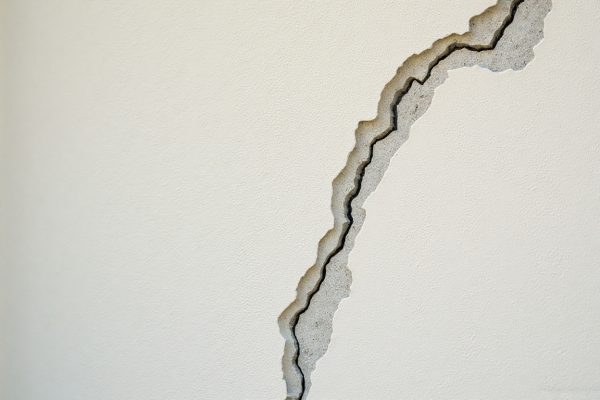
3. Hairline cracking stops after curing, while structural cracking worsens with time
Hairline cracking appears early and remains relatively stable, while structural cracking worsens as movement continues. Hairline gaps usually develop shortly after installation as moisture leaves the cement-based material. Once curing is complete, the cracking pattern stops changing. Width and length remain consistent across seasons. These cracks may reappear through paint or coatings, but do not expand or migrate across the wall.
Structural cracking behaves differently because the source of stress remains active. Ongoing foundation movement, framing deflection, soil shift, or seismic forces continue to load the wall system. As movement repeats, the crack widens, lengthens, or branches into adjacent areas. New gaps may form near the original location, around windows and doors, or at substrate changes. Surface patching fails because the wall continues to move beneath the EIFS.
4. Hairline cracks can be sealed, while structural cracks require corrective repair
Hairline cracking can be sealed with surface treatments, while structural gaps require corrective repair that addresses movement. A hairline crack is repaired by cleaning, sealing, and coating the surface to prevent moisture from entering. Elastomeric sealants or coatings bridge the crack and move with minor expansion. A surface patch works only when the crack does not extend beyond the finish coat. The goal is protection, not reinforcement.
Structural cracks cannot be fixed with a surface patch. Applying sealant over a deep crack traps moisture and masks ongoing movement. Proper repair starts with opening the crack to assess depth and direction. Damaged EIFS is removed to expose the base coat and substrate. The repair rebuilds layers in sequence, restores continuity, and integrates control joints or reinforcement where needed. This approach prevents repeat cracking and hidden damage.
Choosing the correct fix depends on crack depth and cause. Surface cracking allows sealing. Structural cracking demands removal, correction, and full repair of the wall system.
5. Hairline stucco cracks affect appearance, while structural cracks cause functional damage
A hairline crack affects surface appearance, while a structural crack causes functional damage to the wall system. Hairline stucco cracks appear as fine lines in the finish. They may telegraph through paint or coatings, but do not reduce load transfer or wall performance. Repairing these focuses on preventing moisture entry and restoring a uniform appearance. A surface patch or flexible sealant is sufficient when the crack stays shallow.
Structural cracks compromise performance. The crack creates a pathway for water to enter behind the EIFS, where it can affect insulation, sheathing, or framing. Repeated wetting accelerates deterioration and increases the scope of repairs. A cosmetic fix or patch does not stop this process. Proper repair requires removing damaged material and correcting the failure path.
Depend Exteriors Offers Stucco Crack Repairs in Edmonton AB
Depend Exteriors provides targeted stucco crack repair that addresses surface damage and deeper structural issues correctly. From sealing hairline gaps to repairing structural damage, our team applies proven methods that protect the wall system and prevent repeat failure. Call Depend Exteriors at (780) 710-3972 to schedule an inspection and get reliable solutions in Edmonton, Alberta.
FAQs
How to seal hairline cracks in stucco?
Clean the surface, remove dust and loose material, and apply a flexible elastomeric sealant into the fine separation. Next, coat with a breathable exterior finish to block moisture while allowing movement.
Are hairline cracks in stucco normal?
Yes. Fine surface separation is common as stucco cures and dries, and as it responds to temperature changes. This condition is expected and does not indicate structural failure when movement is minor and uniform.
What are the different types of stucco cracks?
Stucco separation generally falls into surface-level hairline separation, stress-related linear separation near openings, and deep structural separation tied to movement in the building or foundation.
If you’re unsure whether cracks on your home are cosmetic or structural, consult an experienced Highlands stucco repair contractor for proper diagnosis.


